10 February 2024
Sangan Island Conservation are proud to offer this one day training course aimed at arborists, early-career ecologists, rangers, and anyone involved in tree or woodland management. The course is an introduction to bats, bat ecology, bat use of trees, the Wildlife (Jersey) Law 2021, and arborist licensing.
Course Overview
Bats can roost in trees through the year and may be present as individuals, small groups, or large maternity colonies. Bats are protected species under the Wildlife (Jersey) Law 2021, with both bats themselves as well as their breeding and resting sites being full protected.
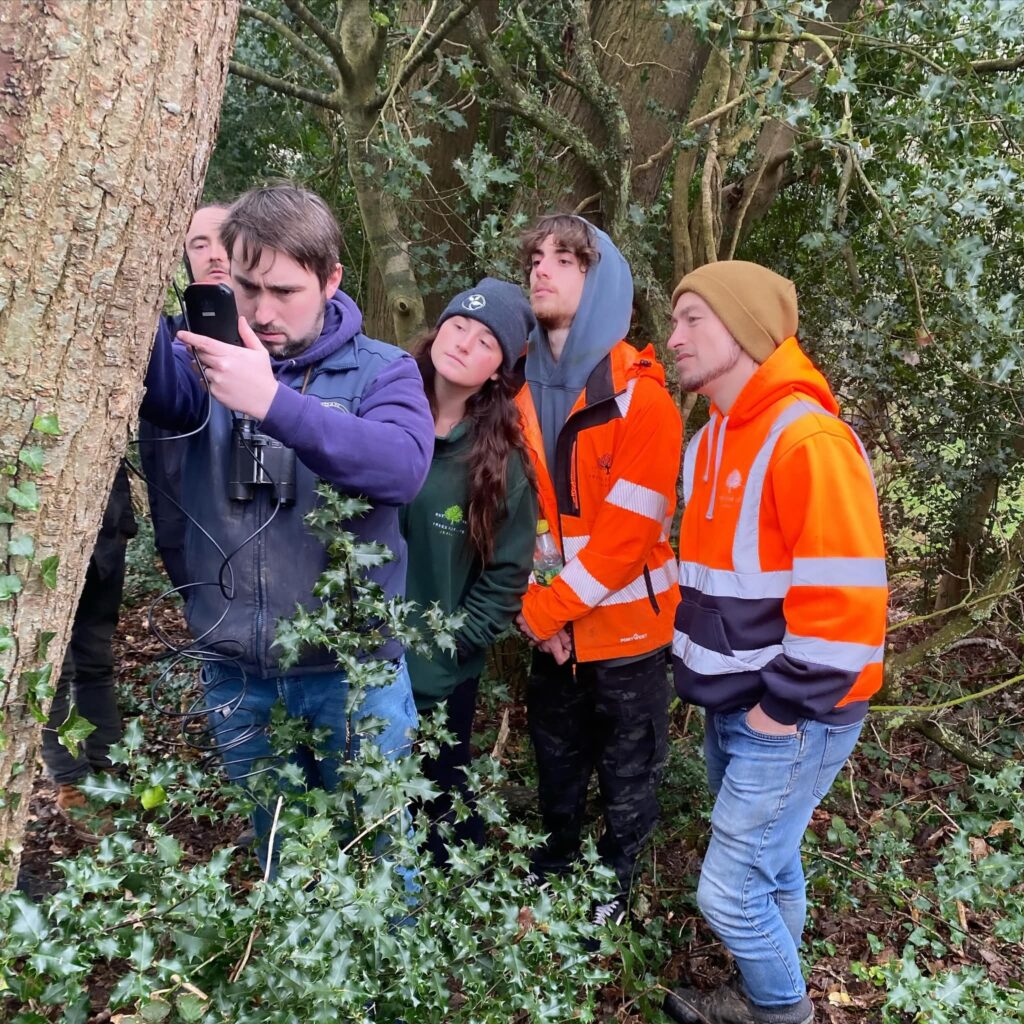
There is always the potential for people working with trees to come across a bat when undertaking their work. Following this course, you will be able to undertake work to trees whilst considering the potential impacts on bats and their habitats. The course will explain how to work within the law with respect to bats. It will teach you how to undertake ground assessment for potential roost features (PRF) as well as how to scope a PRF to prove the absence of any bats prior to undertaking any tree work.
The course will combine a morning classroom session, followed by an afternoon practical session. The day will close with presentations from participants to the group and a questions and answer session.
Course Aims and Objectives
The aims of the course are to:
- To provide sufficient information to enable you to carry out works to a tree whilst considering any potential impacts on bats or the habitats they use.
- To understand the legal protection for bats and bat roosts in England, Wales and Scotland.
- To understand the actions permitted under the annual licence to carry out secondary roost surveys in trees for conservation purposes (AL10).
- To be able to describe and to demonstrate the appropriate method for assessing bat potential in from ground surveys.
- To demonstrate appropriate skills in using cold torches and endoscopes when confirming an absence of bats in a potential roost feature.
By the end of the course the participants will be able to:
- Understand the features on a tree that may be used by bats as potential roosting sites.
- Describe the life cycle of bats and understand how they may use trees throughout the year.
- Know when to seek expert advice from the Environment Department or from local Ecologists.
- Recognise the consequences of disturbing and or destroying a bat roost or trees neighbouring a bat roost.
A certificate of attendance will be provided following completion of this course.
The course amounts to 6 hours of CPD and can be logged as structured learning with your professional bodies.
Meet Your Trainers
Dr Amy Louise Hall BSc (Hons), MRes, LLM, CBiol, MRSB, MCIEEM, MArborA, FLS
Amy is the Director of Research and Training at Sangan Island Conservation which is based in the Bailiwick of Jersey.
Amy has more than 20 years’ experience working with small mammals and bats in the UK and other Channel Islands as well as several field work studies that have been undertaken in South America and the Caribbean.
Amy has been a trainer for more than 20 years, first starting as a trainer at university, then later teaching IT at evening classes at Highlands College for 12 years. Amy taught on a graduate certificate course validated by the University of Kent, and more recently Amy has been involved in teaching several modules for a University of Exeter MSc course as well as teaching ecological skills and advanced techniques courses to trainees in the Bailiwick of Guernsey
Amy’s research has always focused on Bats, small mammals, trees, and habitats, and this continues to be the main theme of current research. Her MRes dissertation researched the use of small farm woodlands by bats, her LLM looked specifically at the protection afforded to bats under the English and Jersey legal regimes, and whether these jurisdictions with convention compliant. Amy’s PhD researched small mammal movement patterns in habitat mosaics.
Piers Sangan BSc (Hons), MSc, MRSB, MCMA
Piers is the Company Founder, Director and Principal Ecologist at Sangan Island Conservation Ltd.
A wildlife ecologist and conservation land manager with more than 15 years’ experience working with small mammals and bats in the UK, and the Channel Islands. As well as management of protected conservation areas and farm biodiversity plans.
Piers’ research has focused on Bats, and habitats. Current research is focusing on grey long eared bats and species range changes in European praying mantids. His MSc dissertation researched the Roosting ecology and phenology of grey long eared bats in Jersey.
Piers has been involved as a guest lecturer for a University of Exeter MSc course as well as teaching ecological skills and advanced techniques courses to trainees in the Bailiwick of Guernsey. Piers has also delivered a number of presentations to conferences and educational webinars, relating to grey long eared bats and farming and biodiversity. Piers is a member of the (LEAF) Technical Advisory Committee and is a qualified tree climber.